

Nasolabial Folds vs Marionette Lines: What’s the Difference and How Are They Treated?
Lines around the mouth are a natural part of facial aging, but nasolabial folds and marionette lines are not the same. They appear in different areas and may be influenced by facial volume changes, skin laxity, muscle movement, and changes in the underlying facial structure.
Understanding what is causing the line is important because the most visible crease is not always the only area that needs to be addressed.
1. Nasolabial Folds vs Marionette Lines
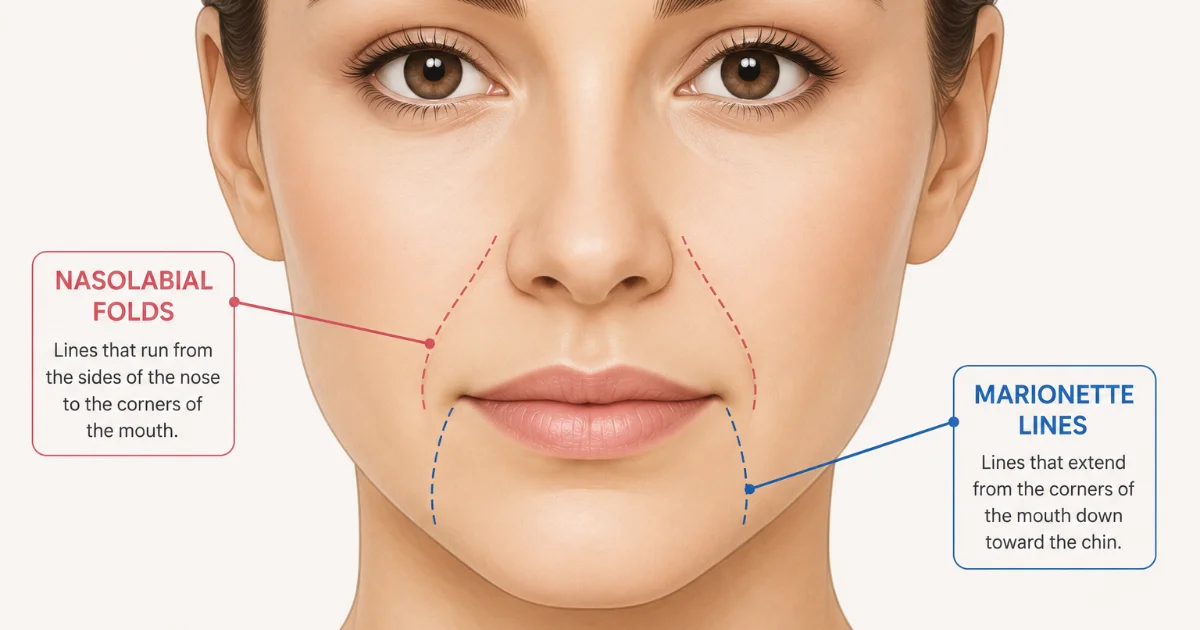 Nasolabial folds extend from the sides of the nose toward the corners of the mouth and are commonly called smile lines or laugh lines.
Marionette lines begin around the corners of the mouth and extend downward toward the chin.
Both can become deeper over time as facial volume, skin elasticity, and structural support change. Because the causes can differ from person to person, treating the visible line alone may not always create the most natural result.
2. What Treatments Can Be Considered?
 The appropriate treatment depends on what is contributing most to the lines.
Botox
Botox may be considered when muscle movement contributes to a downturned appearance around the corners of the mouth, particularly in selected cases involving marionette lines.
Because the muscles around the mouth play an important role in facial expression, careful assessment of facial anatomy and movement is important before treatment.
Injectable Filler
Injectable filler can be used to restore facial support and soften the appearance of certain folds.
For nasolabial folds, treatment does not always mean injecting directly into the deepest part of the line. Changes in the cheeks and midface may also contribute to the appearance of the fold, so the overall facial structure should be evaluated.
For marionette lines, filler may be considered when volume loss or changes in lower facial support are contributing factors.
Threads
Thread lifting uses absorbable threads placed beneath the skin to provide a temporary lifting effect.
It may be considered for selected patients with facial sagging, including concerns around the lower face. However, results and suitability can vary depending on facial anatomy and the degree of skin laxity.
Threads should therefore be considered as one possible option rather than a replacement for every type of facial lifting treatment.
Plastic Surgery
When significant skin laxity and structural facial aging are the main causes of deep nasolabial folds or marionette lines, nonsurgical treatments may have limitations.
In these cases, surgical facial lifting procedures may be considered to reposition deeper tissues and address more advanced sagging.
3. Which Treatment Is Right for You?
 Two people with similar looking folds may need completely different approaches.
One person may primarily have volume loss, another may have stronger muscle activity, while someone else may have more advanced skin laxity. This is why nasolabial folds and marionette lines should be evaluated as part of the entire face rather than as isolated wrinkles.
The cheeks, mouth, chin, jawline, facial movement, volume distribution, and degree of skin laxity should all be considered when determining whether Botox, injectable filler, threads, plastic surgery, or a combination of approaches may be appropriate.
If you are considering treatment for nasolabial folds or marionette lines, consult with a specialist at AB Clinic Gangnam to determine an approach that suits your facial anatomy, concerns, and desired results.
- Written by
- AB Medical Editorial Team
- Medically reviewed by
- Seon-Hong Kim (DERMATOLOGIST)
- Updated on
- 2026.11.13

This article is for informational purposes only and does not replace a personal medical consultation.
For more details, we recommend visiting AB Clinic and consulting with our dedicated dermatology specialists. For inquiries about treatment costs and other procedures, please check the link below and leave a consultation request. We'll get back to you as soon as possible.