

Ultherapy vs Thread Lifting: Understanding the Right Lifting Option for Your Face, Including Effects and Key Differences
If you have been torn between Ultherapy and thread lifting while considering a lifting treatment, you are not alone.
As we age, skin elasticity gradually declines and facial contours become less defined. When the jawline begins to sag or the nasolabial folds become more noticeable, many people start looking for a lifting treatment that can create a firmer and more refined facial profile.
At that point, two options are often compared: Ultherapy and thread lifting. In consultations, patients frequently ask questions such as:
✔ Is Ultherapy alone enough
✔ Would thread lifting be more effective
✔ What is the difference between the two treatments
Both procedures are designed to improve skin firmness and reduce sagging. However, they are not the same. They differ in:
✔ How they work
✔ What kind of results can be expected
✔ How long those results usually last
Because of these differences, the most suitable treatment depends on the individual’s skin condition and the degree of facial laxity.
In this article, we will take a closer look at the differences between Ultherapy and thread lifting, the benefits of thread lifting, the recommended treatment interval, and the cases in which combining both procedures may be worth considering.
How Ultherapy and Thread Lifting Differ in Their Mechanisms
 How Ultherapy Works
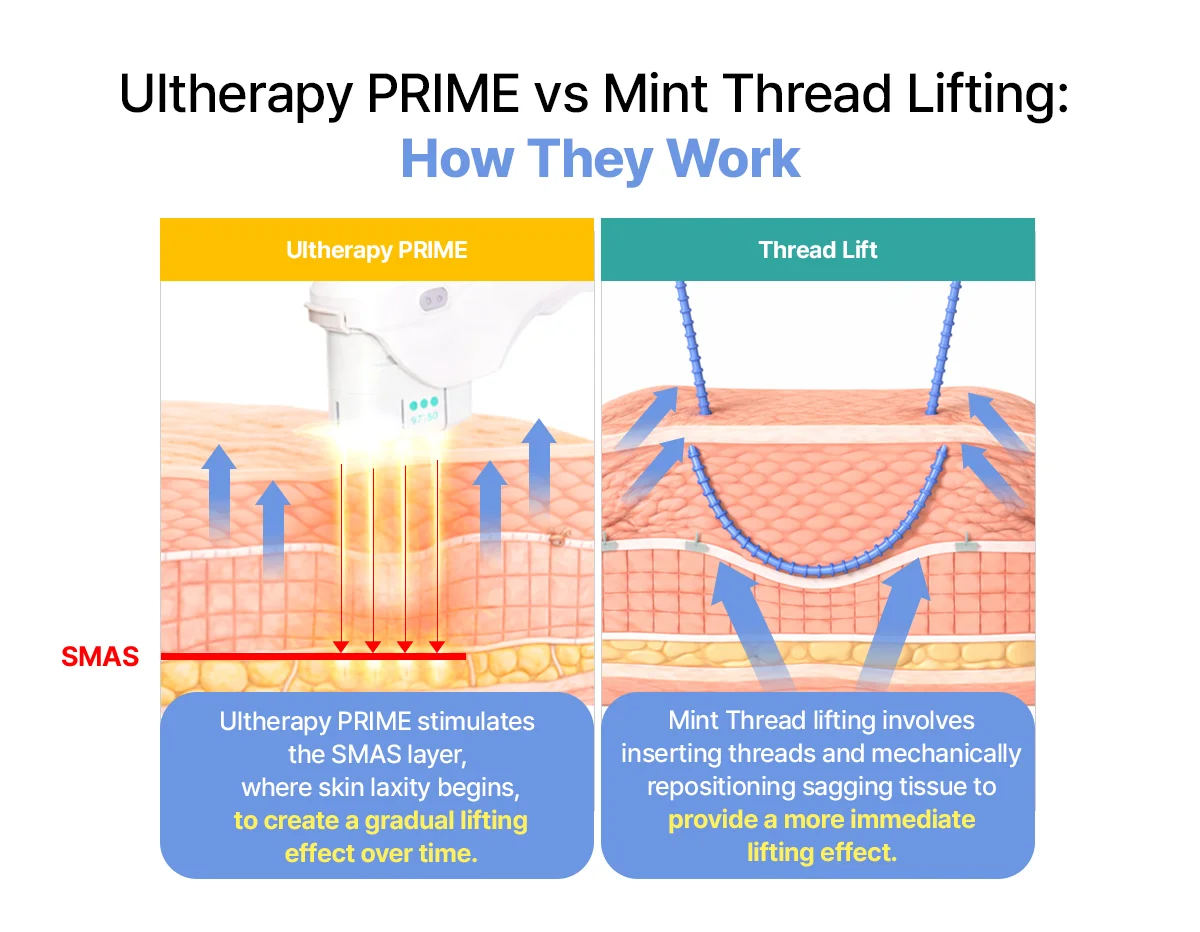
Ultherapy is a lifting treatment that uses high intensity focused ultrasound, or HIFU, to deliver energy deep into the skin.
The ultrasound energy reaches the SMAS layer, which is an important structural layer involved in maintaining skin firmness. There, it stimulates collagen regeneration and gradually improves skin elasticity.
As collagen production increases within the skin, firmness is restored over time and a natural lifting effect begins to appear.
In other words, Ultherapy can be understood as a nonsurgical lifting treatment that focuses primarily on improving skin elasticity.
How Thread Lifting Works
Thread lifting is a procedure that involves inserting specialized medical grade threads into the skin in order to physically lift sagging tissue.
The level of support and longevity may vary depending on the type of thread used, such as cog threads or Mint threads, but the overall principle remains the same.
Once inserted, the threads create a supportive structure within the skin and lift sagging tissue upward, allowing for a more immediate lifting effect.
In addition, collagen production around the threads is stimulated over time, which may also help improve overall skin firmness.
Ultherapy vs Thread Lifting: Effects and the Best Candidates for Each Facial Type
 When choosing a lifting treatment, the most important factor is not simply the name of the procedure.
What matters more is the degree of facial sagging and the current condition of the skin’s elasticity.
When Ultherapy May Be a Suitable Option
Ultherapy may be helpful in the following cases:
✔ When skin elasticity has just begun to decline
✔ When there is a need to improve fine lines or overall skin firmness
✔ When a natural and gradual lifting effect is preferred
✔ When facial sagging is still relatively mild
In particular, for patients in their early to mid 30s, when a decrease in skin elasticity often begins to appear, Ultherapy alone may provide noticeable improvement.
When Thread Lifting May Be a More Suitable Option
Thread lifting may be more effective in the following cases:
✔ When sagging in the cheeks is more noticeable
✔ When the jawline has become less defined
✔ When the nasolabial folds have deepened
✔ When overall facial contour improvement is needed
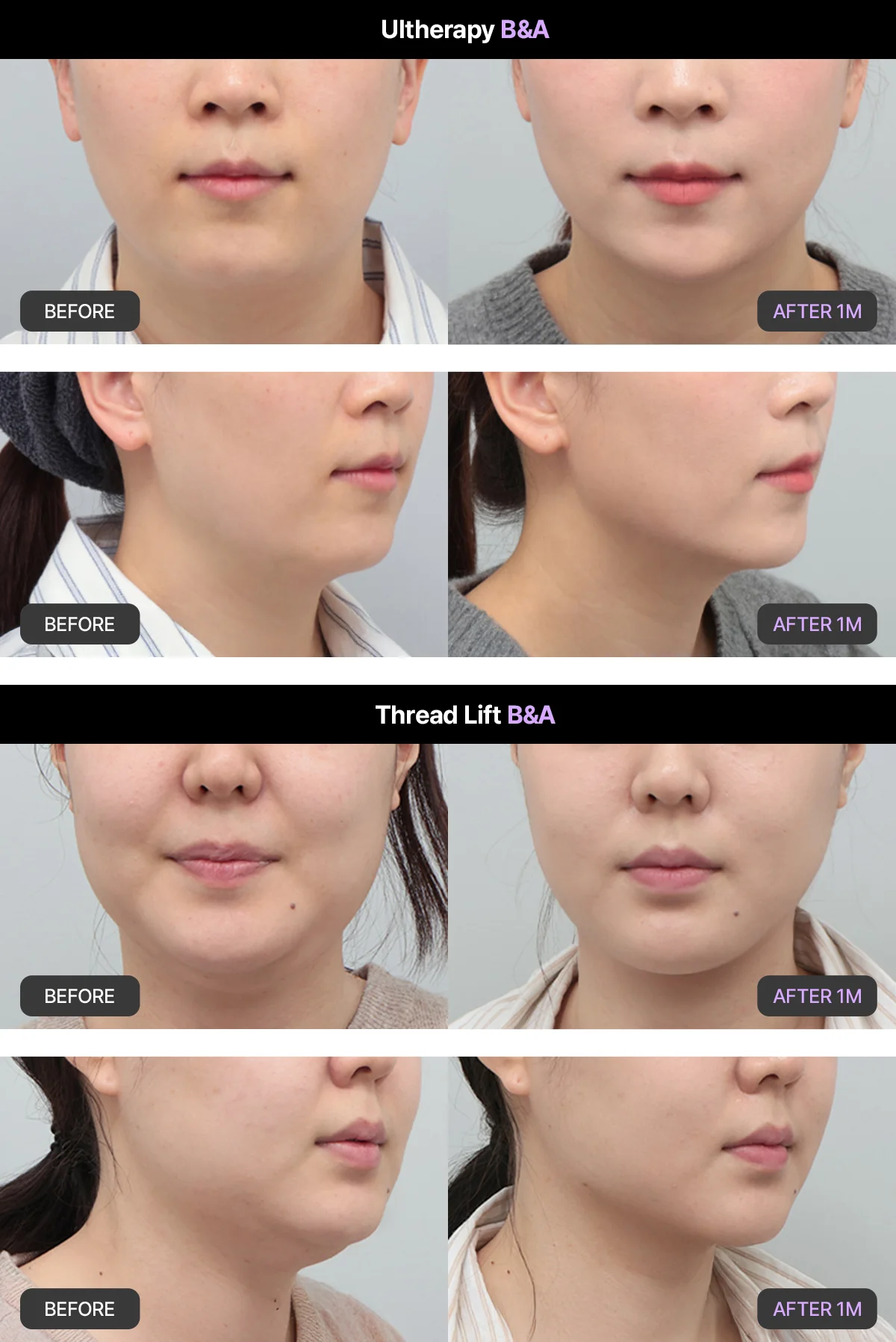
In these cases, thread lifting can produce visible results relatively quickly. Patients are often able to notice a more defined and refined facial line soon after the procedure.
Duration of Results and Recommended Treatment Interval for Ultherapy and Thread Lifting
One of the most common questions patients have is how long the results last and how often treatment should be repeated. Because Ultherapy and thread lifting work differently, their duration and maintenance intervals are also different.
Ultherapy Duration
Ultherapy stimulates collagen production deep within the skin. Its full effect does not usually appear right away. Instead, improvements in skin firmness and elasticity tend to appear gradually, usually beginning around 2 to 3 months later.
In most cases, the results last about 6 months to 1 year. For patients who want to maintain skin elasticity over time, the treatment is often considered once a year.
Thread Lifting Duration
Thread lifting works by physically lifting sagging tissue, so results are usually visible soon after the procedure. Over time, collagen production around the threads may also help support skin firmness.
Although the duration varies depending on the individual’s skin condition, the results often last about 1 year to 1 and a half years.
Quick Comparison
✔ Ultherapy: Gradual improvement, collagen regeneration, about 6 months to 1 year
✔ Thread lifting: Immediate lifting effect, about 1 year to 1 and a half years
When comparing the two, duration alone should not be the only deciding factor. It is more important to consider the degree of sagging, the condition of the skin, and the most appropriate treatment interval.
When Ultherapy and Thread Lifting Are Considered Together
 Recently, rather than viewing Ultherapy and thread lifting as two separate options to compare, many patients and clinicians have begun approaching them as part of a combined lifting strategy.
For example:
✔Ultherapy helps improve skin elasticity
✔Thread lifting directly lifts sagging tissue
When these two treatments are appropriately combined, they can create a more balanced and comprehensive lifting effect.
In particular, when reduced skin elasticity and tissue sagging appear at the same time, considering both treatments together may help achieve a more natural looking lifting result.
- Written by
- AB Medical Editorial Team
- Medically reviewed by
- Seon-Hong Kim (DERMATOLOGIST)
- Updated on
- 2026.11.13

This article is for informational purposes only and does not replace a personal medical consultation.
For more details, we recommend visiting AB Clinic and consulting with our dedicated dermatology specialists. For inquiries about treatment costs and other procedures, please check the link below and leave a consultation request. We'll get back to you as soon as possible.